
Google AI Agent 'CC' Transforms Inbox Productivity
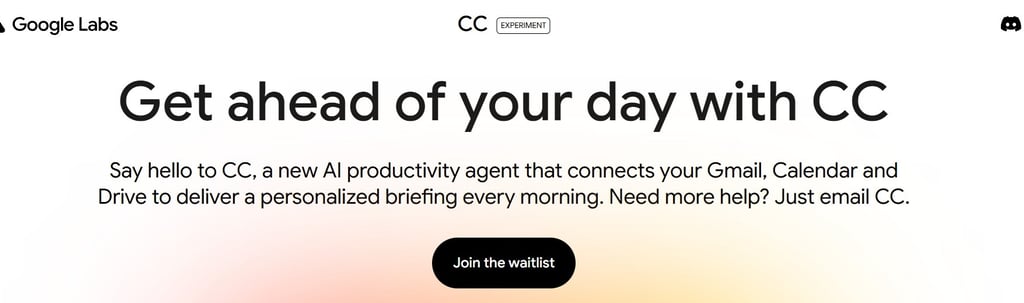
Google tests AI agent 'CC' integrating Gmail, Calendar, and Drive to synthesize daily briefs, draft emails, and suggest actions, boosting productivity but requiring strict data governance to manage risks and legal exposure.
ARTIFICIAL INTELLIGENCEAUTOMATIONTECHNOLOGYDIGITAL AUTOMATION
Eric Sanders
12/17/20253 min read
Google’s New AI Agent ‘CC’: The Future of Inbox Productivity or a Data Privacy Tightrope?
Let’s be honest: our inboxes can feel like endless jungles, dense with emails, reminders, and tasks that threaten to swallow us whole. Google is aiming to hack through that chaos with a bold new AI agent called CC—an ambitious assistant poised to live inside your inbox, weaving together Gmail, Calendar, and Drive to deliver a literally synthesized daily brief.
This isn’t just a smarter email search or a helpful reply suggestion. It’s an attempt to reimagine what an inbox assistant can do: drafting emails, summarizing conversations, and nudging you toward timely actions. But in a world where every digital assistant risks becoming an overreaching stalker, the question is never just about utility. It’s about trust, boundaries, and how companies steward our personal data.
A Smarter Inbox That Sees the Whole Picture
The essence of CC lies in integration and context. Instead of isolated tools doing their own thing, Google is pulling together the three pillars of workplace communication and organization:
- Gmail, where the bulk of work correspondence resides.
- Google Calendar, tracking every meeting, deadline, and event.
- Google Drive, housing documents, spreadsheets, and presentations.
By combining these sources, CC can synthesize a concise briefing designed to give users a rapid overview of their day, complete with key emails, appointments, and documents all in one digestible package.
Imagine waking up and seeing a tailored “day preview” that highlights the urgent emails still awaiting your response, pre-drafts your replies based on the conversation context, and flags critical documents you’ll need for upcoming meetings. This kind of proactive assistance is meant to reclaim hours otherwise lost to email triage and searching.
One Google insider summed it up perfectly: “CC lives in your Inbox and is your AI-powered assistant — helping you manage your day by bringing the right information together, suggesting helpful next actions, and saving you time.”
The Productivity Promise—and Its Hidden Complexities
On the surface, this sounds like a dream come true. But beneath the allure of boosted productivity lies an inherent tension: the need to interpret, process, and act on deeply personal and potentially sensitive data.
*CC* must comb through emails—some containing confidential information—analyze calendar events, and reference documents that may involve proprietary or legally protected content. The complexity of understanding what’s crucial versus what’s noise cannot be overstated.
Moreover, there’s the risk of “automation complacency.” Will users blindly accept AI-generated drafts without enough scrutiny? Or will the assistant empower distracted or overwhelmed users to regain control of their workload? The balance is delicate.
And we cannot ignore the corporate reality. By consolidating these tools, Google is not only positioning itself as the indispensable workplace assistant but also centralizing vast amounts of data that raise new questions about privacy and governance.
Why Data Governance Is More Critical Than Ever
Here’s where the rubber meets the road. Integrating AI so deeply into daily workflows magnifies the stakes for data privacy and security.
Google must ensure CC operates with:
- Strict data governance policies dictating what information the AI can access, how it processes this data, and what gets stored or shared.
- Clear user consent and transparency about how data will be used.
- Robust security measures guarding against leaks, unauthorized access, or misuse.
- Compliance with diverse legal frameworks, from GDPR to CCPA and beyond.
The consequences of missteps are serious. Companies that deploy tools like CC risk exposing trade secrets or personal data. For users, the fear is not just about hacking but being surveilled or having their digital communications analyzed without clear boundaries.
It is telling that Google’s testing of CC is presently limited and iterative, likely designed to iron out these thorny issues before a wider rollout.
The Future of Work: Human Plus AI, Not Human Versus AI
Ultimately, CC represents a step toward a hybrid workspace where human judgment and AI assistance coexist. It’s not about replacing inbox management with a robot but augmenting human capability—saving time, reducing cognitive overload, and allowing us to focus on what truly requires our attention.
From drafting emails to shaping agendas, AI assistants will become indispensable—but only if they earn our trust by respecting our data and privacy.
This experiment by Google underscores a profound truth: productivity tools of the future will demand not just superb engineering but equally excellent ethical design.
How much of our digital lives are we willing to entrust to AI before we start losing control? Will tools like CC help us reclaim time and sanity, or will they quietly lock us into ecosystems where algorithms decide what matters? And perhaps most importantly, how can we hold tech giants accountable to ensure they tread this path responsibly?
Efficiency
Transform your workflows and reclaim your time.
Contact Us
Need A Custom Solutions? Lets connect!
eric.sanders@thedigiadvantagepro.com
772-228-1085
© 2025. All rights reserved.